Xyna 11 :: AI-Release
Xyna Bulletin #33
Dear friends, partners, and customers of Xyna,
The desks are tidy, the out-of-office replies are switched off. And, as promised before the summer break, we return with exactly the topic we teased back in July: Xyna 11, scheduled for release in October 2026.
Long-time readers know that our major version numbers don't follow the calendar; they follow technological leaps. Xyna 10 earned its number with XyPilot and generic OAS support. Xyna 11 earns it with something more fundamental: the platform becomes natively AI-enabled. Not by bolting a chat window onto the Modeller, but by giving every Xyna-based system two things it has not had before: a native MCP interface, and an AI backend that runs inside your own installation. Plus, a full basket of additional benefits like an enhanced Shared Resource Management, Angular 22, or Java 21.
This issue is entirely dedicated to that release: what's in it, where we currently stand, and what it means for your projects.
Happy reading!
Best regards from Mainz,
Alexander & Philipp
::
MCP Interface — AI-Ready by Design
Anyone who has followed the agentic AI discussion over the past months (and our Catalyst project in Copenhagen in particular) knows the recurring bottleneck: the model is rarely the problem. The problem is giving an agent controlled, traceable access to the data and business functions of the systems that actually run the network.
With Xyna 11, Xyna speaks the Model Context Protocol (MCP) natively. That turns every Xyna-based system into an AI-ready platform: agentic AI can access the data and business functions of Xyna-based applications, without a custom integration layer built for each individual use case.
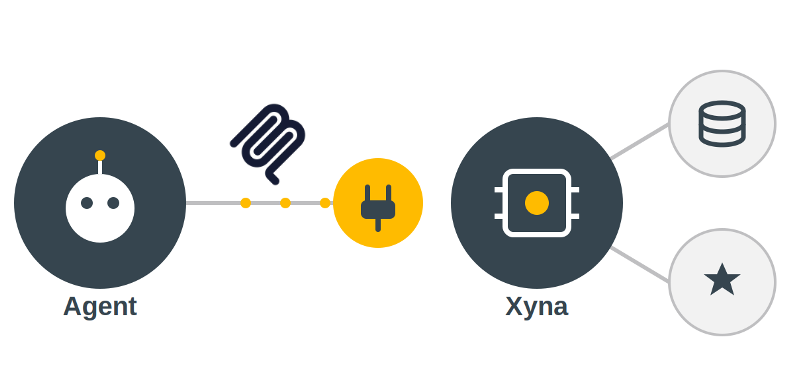
What this looks like in practice is a set of interface applications that expose Xyna capabilities as MCP tools, grouped in MCP servers.
For the initial Xyna 11 release in October, we are adding a first application that makes various OAS capabilities callable via MCP; among them the generation of Xyna applications directly from an API specification. Read that twice, because it is the interesting part: an agent can take a TM Forum Open API specification and have Xyna build the corresponding application from it.
This is also the first shipped application that extends the functional scope of the MCP server rather than merely using it. It won't be the last, we expect to add further ones in subsequent releases.
Possible further MCP tooling might include:
- CLI API: operations, monitoring, and the usual administrative surface
- Modeller API: development support, e.g., XMOM search function
::
Local LLM Hosting — Your Own AI Backend, Built In
The second pillar of Xyna 11 is one we have been arguing for since our "AI Beyond the Mainstream" keynote: AI in critical infrastructures should not require shipping your operational data to somebody else's data centre.
Xyna 11 lets you run an open-source language model (e.g. Ministral, Qwen, or Gemma) on a dedicated inference server, right inside your Xyna installation. Xyna ships the complete AI backend out of the box, including language processing and MCP-call orchestration. What remains on your side is the front end and the exposure/API layer.
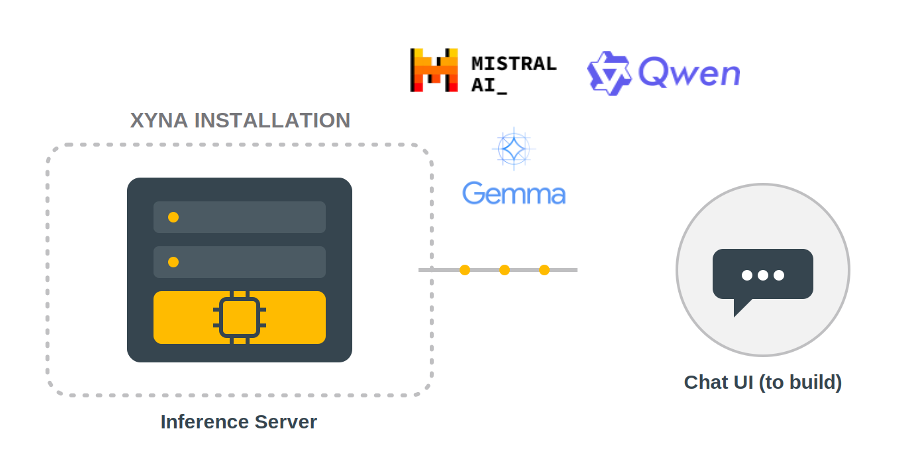
Together with the MCP interface, this closes the loop: a model you host, talking to functions you control, over a protocol that is becoming the industry default. For anyone operating under NIS-2, sector-specific regulation, or simply a sober data protection policy, that combination is worth a closer look.
Outlook: we are also evaluating whether XyPilot can be pointed at a locally hosted model. Potentially large benefit, but as of today an evaluation, not a release commitment. We'll report back.
::
Xyna SRM — The Next Stage
In Bulletin #30 we introduced Xyna Shared Resource Management, the mechanism that keeps capacities, vetoes, and IDs consistent across loosely coupled container nodes in cloud-native setups.
Xyna 11 extends its coverage:
- OrderBackup support
- Cron-like orders
- Shared vetoes
For anyone running Xyna nodes under Kubernetes or OpenShift, this meaningfully widens the set of applications that can be operated in an elastically scaled setup.
::
Xyna Zeta — Angular 22
Bulletin #29 reported our move to Angular 21. Google's release cadence being what it is, that statement had a limited shelf life, and so Xyna Zeta moves to Angular 22 with Xyna 11.
This step brings breaking changes, which is precisely why we are doing it now: a major version boundary is the right place for them, and it puts Zeta back on the current Angular version rather than one release behind it.
::
Supported Base — A Word on Java
One housekeeping item, and one where we would genuinely like to hear from you.
With Xyna 11 we intend to compile our jars with Java 21 and to discontinue support for Java 11. Dropping the old version noticeably reduces effort in both delivery and regression testing.
To the best of our knowledge, no active project depends on Java 11. If yours does, now is the moment to tell us: a short mail to xyna@xyna.com, and we will factor it in.
::
Curious to See It Live?
The most interesting conversations about AI in network operations tend to start at a screen rather than in a slide deck. So: we are happy to walk you through a hands-on demo of the MCP interface and the local inference setup, including a proof of concept tailored to your own use case.
Just get in touch. October is closer than it looks. :)