Dry lab as a service:

xyna.bio

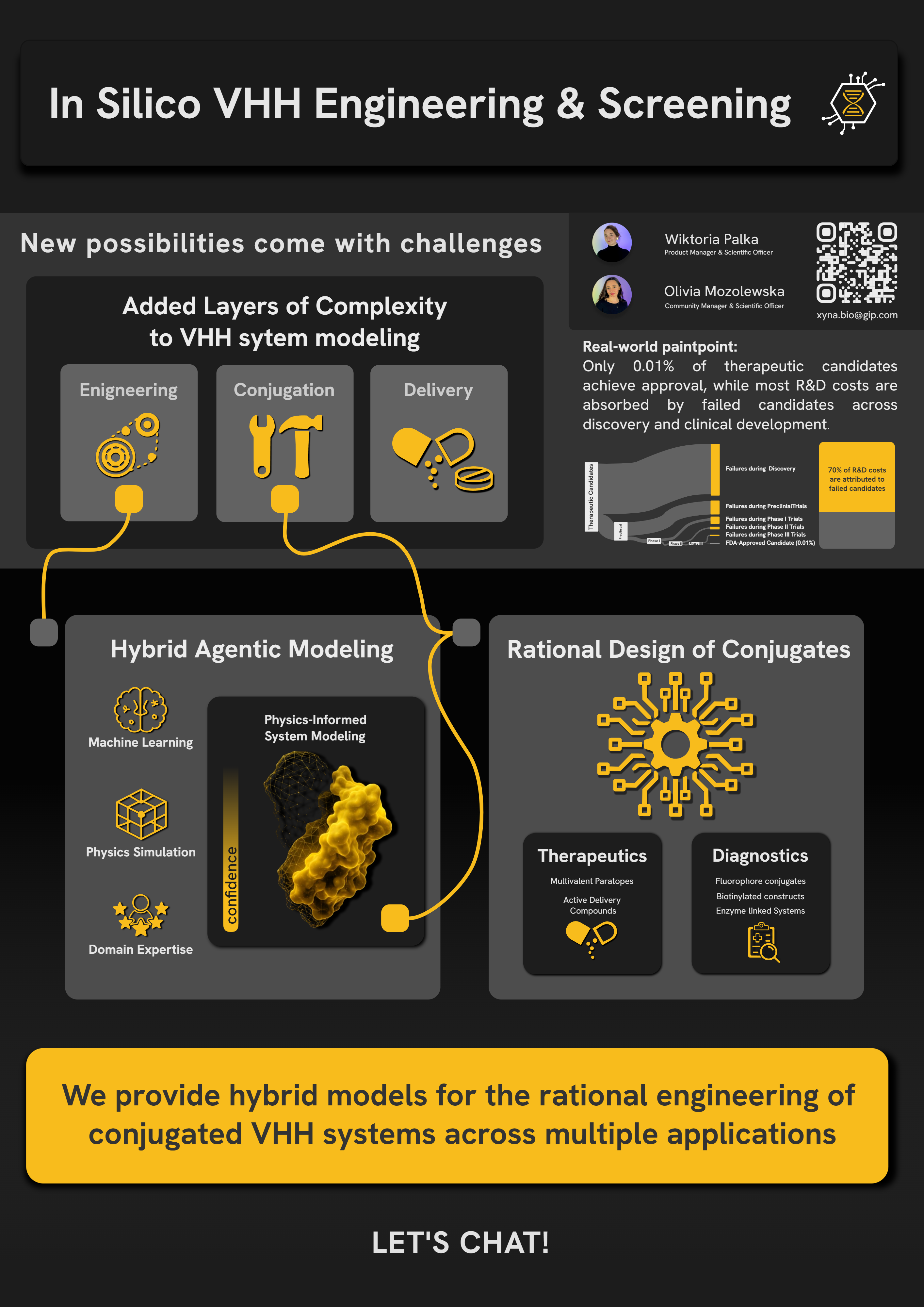
We are a Contract Research Organization for in-silico Antibody screening with strong focus on VHH based drug conjugates engineering.

hybrid modeling ○ AI orchestration ○ closed-loop systems ○ virtual screening 

driven by our fast & efficient hyperautomation platform

Our Vision

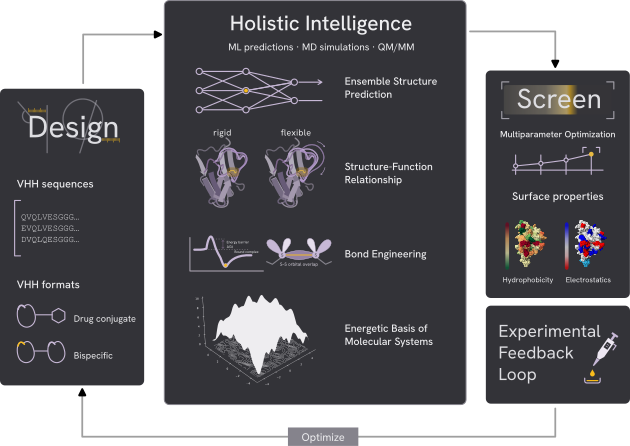
We envision a future where VHHs, NDCs, and multifunctional biologic systems can be engineered through continuous interaction between simulation, AI-driven modeling, and experimental validation.

Our goal is to establish intelligent engineering workflows that bridge dry lab and wet lab to enable scalable development of highly targeted biologic therapeutics.

Model, simulate and optimize complex molecular systems before they enter the lab

VHHs and VHH-based conjugates are enabling a new class of targeted therapeutics with highly specialized functionality.

To fully realize their potential, these systems must be understood not only at the molecular level, but as dynamic functional entities with complex structural and biophysical behaviour

xyna.bio combines simulation, modeling, and human-guided computational workflows to support the in-silico design of these systems before they are validated in the lab.

Our Mission

Supporting our clients in accelerating the design of VHH-based therapeutics through advanced in-silico engineering workflows.

  • Tailored data pipelines built to your specific workflows
  • Request custom analytics tools
  • Optimized for batch processing and high-throughput performance
  • Reliable, secure data handling
  • Priority support and direct collaboration with our technical team

Video

Design More Stable Nanobodies: Full Walkthrough of xyna.bio’s Aggregation Pipeline

Watch our walkthrough video for the Nanobody Aggregation Score Pipeline!
In this demo, we show how to predict VHH aggregation risk using our pipeline developed together with Prof. Dr. Harald Kolmar’s group at TU Darmstadt and Felix Geyer.

If you want to watch embedded videos on this page, personal data (IP address) will be sent to the operator of the video portal (here youtube.com) and cookies will be set on your device. Therefore, it is possible that the video provider stores your accesses and can analyze your behavior. By clicking on "PLAY VIDEO" you consent to the data processing and the setting of cookies.

For more information on data protection, click here: Data Protection

Play Video

Breaking News:

Cooperation with AG Kronberger @Eberhard-Karls Universität Tübingen

We’re excited to announce an upcoming collaboration between xyna.bio and AG Kronberger at Universitätsmedizin Eberhard-Karls Universität Tübingen.This partnership aims to explore new frontiers in VHH engineering:A central goal of the collaboration is to build an AI system that can dramatically accelerate molecular simulations for VHHs. This would allow VHH and conjugates and their interactions to be modeled and analyzed much faster than with traditional computational methodsWe believe that integrating advanced AI with deep scientific expertise will open powerful new possibilities for drug discovery and precision therapeutics.Looking forward to what we will build together

Read moreWednesday, May 13, 2026

More latest articles:

xyna.bio is a sponsor for BFH

Three times - always a charm!We are proud to announce that xyna.bio is a sponsor of the BFH European Meet-Up for a third time this year.It is impressive to see how early collaboration shapes success in later stages of the competition, and we look forward to engaging with the next generation of innovators.

Read moreTuesday, April 14, 2026

San Diego, here we come!

🚀 Heading to BIO International Convention 2026? Let’s connect.We’ll be using the BIO Partnering™ system to connect with innovators across the global biotech ecosystem.At xyna.bio, we’re addressing one of the key challenges in protein engineering and biologics discovery: reducing design uncertainty. Our AI-enabled hybrid modeling approach combines machine learning, physics-based simulation, and expert knowledge to deliver decision-ready insights across the full in silico workflow.We are especially focused on: → VHH / nanobody-based discovery and engineering → VHH-drug conjugates → In silico screening and experimental design acceleration → VHH applications for diagnostics and therapeutic innovationIf you're attending BIO 2026, feel free to reach out via the BIO Partnering™ platform. We’d love to explore how we can collaborate.

Read moreThursday, April 2, 2026

Extended Collaboration with TU Darmstadt

We are excited to share that we extended our collaboration around VHH developability & research with Harald Kolmar's research group at Technische Universität Darmstadt through the end of 2027!  This continuation reflects the strong collaboration and mutual values we have built together and we are proud to keep advancing our shared goals 🔬In a recent discussion with Felix Geyer, we talked about VHH CDR3 flexibility and the role of disulfide bonds.About 10-30% of VHHs contain disulfide bonds in their CDR3 loops, which can shape loop flexibility and potentially influence binding kinetics:CDR3 flexibility could affect both how quickly VHHs are able to engage epitopes and how stable those interactions remain.For nanobody discovery, this raises compelling engineering questions. Can we use the targeted introduction/removal of disulfide bonds or other substitutions that influence flexibility to control loop dynamics in predictable ways?At xyna.bio we think this is exactly where hybrid approaches become powerful. Combining AI driven structure and affinity prediction with physics-based simulations allows us to explore these hypotheses systematically.

Read moreWednesday, March 25, 2026

Follow us on Social Media

Connection beyond platforms

Community-driven innovation is at the heart of xyna.bio. We shape goals and requirements together with you, ensuring that our platform evolves to meet real research needs. So become part of the xyna.bio community! Follow us on social media for the latest updates, insights, and discussions on the future of computational bioscience.

Disclaimer

Use of xyna.bio is intended for research purposes only and not for clinical decision-making. All in silico results, regardless of how obtained, must be experimentally validated. xyna.bio must not be used for the design, development, or facilitation of biological weapons, harmful biological agents, or any illegal, terrorist, or malicious activities.